

What Is a Load Cell?
A load cell is a transducer designed to convert an applied mechanical force into a measurable electrical output. Depending on its construction and installation, it can measure weight, compression, tension, bending, torque, or a combination of forces. Load cells are central components in electronic weighing systems because they provide the raw measurement signal used by indicators, controllers, data acquisition equipment, programmable logic controllers, and industrial computers.
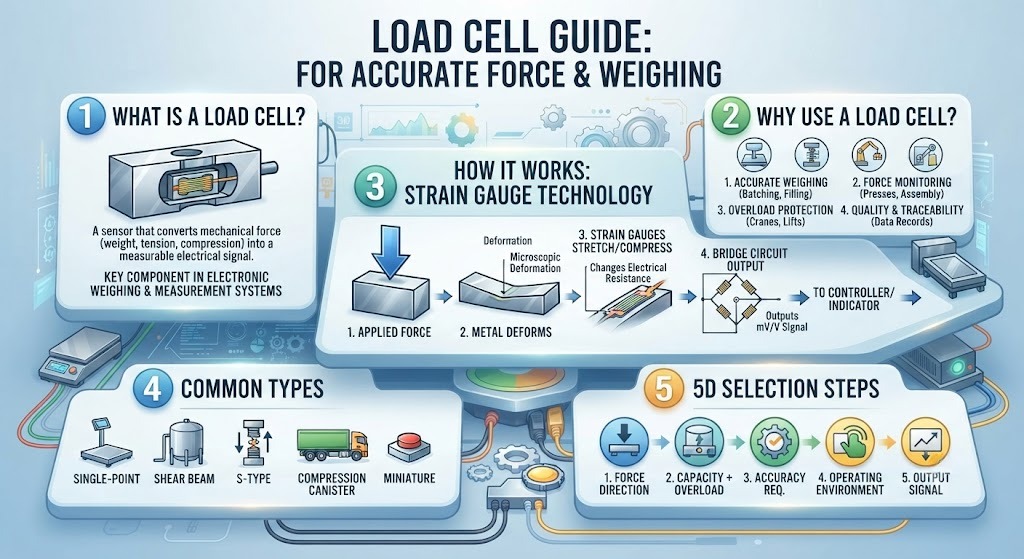
The most common load cell technology uses bonded electrical resistance strain gauges. These strain gauges are attached to a precisely machined metal element, often made from alloy steel, stainless steel, or aluminum. When a force is applied, the metal element deforms by a very small amount. The strain gauges stretch or compress with the element, changing their electrical resistance. A bridge circuit converts this resistance change into a low-level electrical signal that is proportional to the applied load.
How Does a Strain Gauge Load Cell Work?
Most strain gauge load cells use a Wheatstone bridge arrangement. In an unloaded condition, the bridge is balanced and produces little or no differential output. When force is applied, the resistance of the strain gauges changes, unbalancing the bridge and creating a voltage output. This signal is usually expressed in millivolts per volt, meaning the output depends on both the applied load and the excitation voltage supplied to the load cell.
Key point: A load cell does not normally display weight by itself. It produces an electrical signal that must be conditioned, amplified, converted, and interpreted by an indicator, transmitter, controller, or data acquisition system.
Who Uses Load Cells?
Load cells are used by machine builders, automation engineers, weighing equipment manufacturers, material testing laboratories, food and pharmaceutical plants, logistics companies, agricultural operations, construction companies, packaging facilities, and research institutions. They are suitable whenever a process requires accurate and repeatable force or weight measurement.
Why Is a Load Cell Needed?
A load cell is needed when an application requires more than a visual estimate or a mechanical indication. Modern production systems depend on measurable data to control quality, protect machinery, reduce material waste, document results, and automate decisions. A properly selected load cell provides a stable and repeatable signal that allows a system to detect small changes in weight or force.
Accurate Weighing and Dosing
In batching and filling systems, the correct quantity of material must be measured consistently. A load cell can detect the increasing weight of a hopper, tank, bottle, bag, or container and send the measurement to a controller. The controller can then stop a pump, close a valve, slow a feeder, or reject an incorrect product.
Force Monitoring in Machines
Manufacturing processes often require controlled force. Press fitting, clamping, crimping, riveting, sealing, tensioning, and assembly operations may fail if the applied force is too low or too high. A load cell allows the machine to verify that the force remains within an acceptable range.
Overload Protection
A load cell can also protect equipment. For example, a crane, lifting system, platform, cable, or mechanical fixture may have a maximum safe working load. When the measured force approaches a preset limit, the control system can trigger an alarm or stop motion before structural damage occurs.
Traceability and Quality Control
Digital force and weight records can be stored with production data, batch numbers, test reports, timestamps, or operator information. This improves traceability and allows manufacturers to identify process drift before it creates large quantities of defective products.
Common Load Cell Types
Load cells are available in different mechanical forms because no single design is ideal for every installation. The correct type depends on the direction of force, available space, capacity, required accuracy, environmental conditions, and how the load enters the sensor.
Single-Point Load Cell
A single-point load cell is widely used in bench scales, retail scales, checkweighers, counting scales, and small platform systems. Its design compensates for loads applied at different positions on the platform, provided the platform dimensions remain within the manufacturer’s recommended limits. This allows one load cell to support an entire small weighing platform.
Shear Beam Load Cell
Shear beam load cells are common in industrial floor scales, tank weighing systems, hoppers, conveyors, and pallet scales. They provide good resistance to certain side loads and are often used in systems with multiple load cells. Proper mounting hardware is important because thermal expansion, vessel movement, and piping forces can influence the result.
S-Type Load Cell
An S-type load cell can commonly measure both tension and compression. Its shape makes it suitable for hanging scales, suspended hoppers, cable tension systems, testing machines, and force measurement fixtures. Rod-end bearings or suitable adapters are often used to reduce bending and improve alignment.
Compression Load Cell
Compression load cells measure force applied in compression. They are used in high-capacity weighing, structural testing, press monitoring, silo weighing, truck scales, and industrial machinery. Some designs are compact button-style sensors, while others are larger canister or column-type units intended for heavy loads.
Tension Load Cell
Tension load cells measure pulling force. They may be installed in cables, suspended weighing systems, material testing machines, lifting devices, or structural monitoring equipment. Alignment is critical because bending or side loading can introduce errors.
Miniature and Button Load Cells
Miniature and button load cells are designed for applications with limited space. They are often used in robotics, medical equipment, compact testing fixtures, product development, assembly tools, and laboratory instruments. Their small size can make them more sensitive to mounting surface quality and off-axis loading.
How to Choose a Load Cell in Five Steps
Selecting a load cell should begin with the mechanical application, not only the desired capacity. Two load cells with the same rated capacity may perform very differently if one is exposed to side load, vibration, temperature changes, moisture, shock, or an unsuitable mounting structure.
Step 1: Define the Force Direction and Mechanical Arrangement
Determine whether the load cell will measure compression, tension, bending, or bidirectional force. Then examine how the force enters and leaves the sensor. The load should follow the intended load axis as closely as possible. Side force, torque, bending moment, and misalignment can create measurement errors or permanently damage the sensor.
Step 2: Calculate Capacity and Allow for Overload
Calculate the maximum expected working load, including the weight of platforms, fixtures, tanks, cables, product containers, and other permanent structures. Also consider dynamic forces caused by impact, vibration, acceleration, sudden filling, or material movement. Selecting a load cell too close to the normal operating load may create overload risk, while selecting a capacity that is unnecessarily high may reduce usable measurement resolution.
Step 3: Set Accuracy and Resolution Requirements
Accuracy is influenced by nonlinearity, hysteresis, repeatability, creep, zero return, temperature effects, signal conditioning, calibration, mechanical installation, and environmental noise. Do not choose a load cell only by reading one accuracy number. The complete measurement system must be evaluated, including the indicator, amplifier, wiring, mechanical structure, and calibration method.
Step 4: Review the Operating Environment
Check the expected temperature range, humidity, washdown requirements, dust, chemicals, condensation, outdoor exposure, vibration, electrical noise, and corrosion risk. Stainless steel construction and suitable sealing may be preferred in food processing, pharmaceutical, chemical, marine, or outdoor installations. However, enclosure protection alone does not correct poor cable routing or an exposed connector.
Step 5: Confirm Output, Wiring, and Control Compatibility
Traditional load cells provide a low-level millivolt-per-volt signal and require an amplifier or weighing indicator. Other products may include integrated electronics with voltage, current, fieldbus, digital, or serial outputs. Confirm excitation voltage, signal range, cable length, connector type, number of wires, sensing arrangement, and compatibility with the receiving device.
Load Cell Selection Comparison Table
| Load Cell Type | Typical Load Direction | Common Applications | Main Selection Note |
|---|---|---|---|
| Single-Point | Compression through a platform | Bench scales, counting scales, checkweighers | Follow the recommended platform size and mounting direction |
| Shear Beam | Compression or beam loading | Floor scales, tanks, hoppers, conveyors | Use suitable mounting kits and control vessel movement |
| S-Type | Tension and compression | Hanging scales, testing machines, suspended loads | Maintain axial alignment and reduce bending |
| Compression Canister | Compression | High-capacity scales, presses, silos, structural tests | Provide a flat, rigid, centered loading surface |
| Miniature or Button | Usually compression | Robotics, medical equipment, compact test fixtures | Pay close attention to surface flatness and off-axis load |
Common Load Cell Errors and Mistakes
Many load cell problems are caused by installation and system design rather than a defective sensor. Avoiding the following mistakes can improve accuracy, stability, and service life.
- Choosing capacity only from the product weight: The total load may also include platforms, fixtures, tanks, brackets, and dynamic impact.
- Ignoring off-axis force: Side load, bending, or torque can distort the output and damage the sensing element.
- Installing on a flexible structure: A weak or uneven support can shift the load path and create inconsistent readings.
- Applying force to the wrong surface: Many load cells have a defined loading direction, fixed end, and active end.
- Over-tightening mounting hardware: Incorrect torque or clamping can introduce mechanical stress before any actual load is applied.
- Routing signal cables beside power cables: Motors, inverters, relays, and high-current wiring can introduce electrical noise.
- Calibrating before the structure is complete: Covers, piping, hoses, guards, and mechanical attachments may change the zero point or load distribution.
Do Not Use the Load Cell as a Mechanical Stop
A load cell is a precision sensor, not a structural impact stop. If a moving machine component can strike the sensor or exceed its rated travel, use external mechanical stops, overload protection, or shock-absorbing components. Repeated impact may shift the zero point, change sensitivity, or permanently deform the element.
Advanced Tips and Best Practices
Use Proper Mounting Hardware
Purpose-designed mounting kits can reduce installation errors by controlling the direction of force and allowing limited movement caused by thermal expansion. In tank and hopper systems, the correct mounts may also help manage uplift, side movement, and vessel expansion without transferring unwanted force into the load cell.
Protect the Cable and Connector
A sealed load cell can still fail if moisture enters through a damaged cable or connector. Avoid sharp bends, crushing, abrasion, uncontrolled cable movement, and unsupported connectors. Do not shorten or extend cables without checking whether the system uses remote sensing or cable compensation.
Allow Warm-Up and Stabilization
Electronic indicators, amplifiers, and load cells may require time to reach thermal stability. For precision measurements, allow the system to warm up before zeroing or calibration. Avoid calibrating immediately after moving equipment between very different temperatures.
Calibrate the Complete Measurement Chain
Calibration should include the installed load cell, mechanical structure, indicator, amplifier, wiring, and software scaling. Whenever possible, apply known reference loads through the same mechanical path used during normal operation. This helps include real installation effects rather than testing the sensor in isolation.
Create a Preventive Inspection Schedule
Periodically inspect mounting bolts, load introduction points, cables, connectors, seals, junction boxes, mechanical stops, and nearby structures. Compare zero values and known test weights over time. A gradual change may indicate mechanical binding, corrosion, cable damage, foundation movement, or sensor drift.
Typical Load Cell Applications
Load cells are used in both simple weighing devices and complex automated systems. Their flexibility allows engineers to integrate force measurement into machines, production lines, laboratory equipment, and infrastructure.
- Platform and floor scales: Measuring packages, pallets, raw materials, and finished goods.
- Tank and hopper weighing: Monitoring inventory, batching ingredients, and controlling filling operations.
- Material testing: Measuring tensile, compression, peel, break, insertion, and extraction forces.
- Packaging machines: Verifying fill weight and rejecting underweight or overweight products.
- Press and assembly monitoring: Confirming that a part is pressed, crimped, sealed, or assembled with the correct force.
- Crane and lifting systems: Monitoring suspended loads and supporting overload alarms.
- Robotics: Detecting gripping force, contact force, tool load, or interaction force.
- Agriculture and livestock: Weighing feed, grain, fertilizer, animals, and produce.
- Medical and rehabilitation equipment: Measuring patient support force, device force, and test loads.
- Research and development: Recording force during prototypes, experiments, and product evaluation.
Conclusion and Next Step
A load cell is a precision sensor that turns mechanical force into usable measurement data. Although the basic principle is straightforward, reliable performance depends on the complete system. Capacity, load direction, mounting, structural rigidity, environment, wiring, signal conditioning, calibration, and overload protection all affect the final result.
Before purchasing a load cell, define the application in practical terms: what is being measured, how the load enters the sensor, the maximum normal and abnormal force, the required accuracy, the available mounting space, and the operating environment. This information makes it easier to compare load cell types and avoid expensive redesigns.
 立即聯絡
立即聯絡 加入好友
加入好友