

What Is a Pneumatic Grease Pump?
A pneumatic grease pump is an air-powered lubrication pump designed to transfer grease from a pail, drum, tank, or reservoir to bearings, joints, fittings, machinery, or centralized lubrication circuits. Instead of relying on manual pumping, the unit converts compressed-air energy into reciprocating mechanical movement that pushes grease through the pump tube and into the delivery line.
This type of pump is commonly used when lubrication must be performed more frequently, over longer distances, at higher pressure, or at multiple lubrication points. It can be installed on portable grease units, workshop lubrication stations, machinery lubrication systems, service trucks, production lines, agricultural equipment, heavy construction machinery, mining equipment, and other industrial maintenance systems.
One important feature of a pneumatic grease pump is its pressure ratio. Ratios such as 3:1, 5:1, 10:1, 40:1, 50:1, or higher may be encountered depending on the pump design and intended application. The ratio indicates the relationship between the compressed-air pressure acting on the air motor and the theoretical fluid pressure generated by the pump. However, actual operating pressure and flow depend on system resistance, hose size, grease viscosity, temperature, fittings, delivery distance, and the pump manufacturer's operating limits.
Key Point: Do not select a pneumatic grease pump only by looking for the highest pressure ratio. The correct pump should match the grease consistency, required flow, air supply, hose length, lubrication-point resistance, operating frequency, and safety limits of the complete system.
Who Uses Pneumatic Grease Pumps?
Typical users include automotive workshops, truck service centers, fleet operators, factories, steel plants, equipment manufacturers, agricultural operations, construction contractors, mines, machine shops, assembly plants, and maintenance departments. Any facility that performs repeated grease lubrication may benefit from replacing manual pumping with a properly sized air-powered system.
Why Is a Pneumatic Grease Pump Needed?
Manual grease guns are useful for occasional lubrication, but they can become inefficient when a maintenance team must lubricate dozens or hundreds of grease fittings every day. A pneumatic grease pump can reduce repeated manual effort and provide a more practical way to transfer grease through hoses, reels, dispensing valves, and fixed lubrication lines.
1. Frequent Lubrication Tasks
Workshops and industrial facilities may have many lubrication points that require regular service. Repeatedly loading and operating manual grease guns increases labor time. An air-powered system can supply grease from a larger container and allow technicians to concentrate on reaching and servicing the lubrication points.
2. Long Hose Runs
Grease creates significant flow resistance, particularly when temperatures are low or hoses are long and narrow. A pneumatic grease pump can generate the pressure needed to move lubricant through a properly engineered hose and piping system. However, pressure loss should always be considered during system design rather than simply compensating with an oversized pump.
3. Centralized Lubrication
In centralized systems, a pump feeds lubricant to multiple downstream components such as injectors, metering devices, distributors, or lubrication lines. A correctly selected pneumatic grease pump can serve as the grease source for systems where consistent pressurization and repeated lubrication cycles are required.
4. Heavy-Duty Equipment Maintenance
Construction, agricultural, mining, and off-road equipment commonly contain pins, bushings, bearings, and articulating joints that require grease. These applications may involve multiple fittings, difficult access, contamination, and demanding operating environments. An appropriately designed pneumatic grease pump system can make routine lubrication more manageable.
How Does a Pneumatic Grease Pump Work?
A pneumatic grease pump normally contains an air motor and a pumping section. Compressed air enters the motor and moves an internal piston or reciprocating mechanism. This motion is transferred to the pump section, which draws grease into the pump and then forces it toward the fluid outlet.
As the pump cycles, grease travels from the container through the pump tube, outlet fitting, hose, and dispensing equipment. In many systems, the pump continues cycling while grease is flowing and slows or stalls when downstream pressure reaches equilibrium. When grease is dispensed again, the pressure drops and pumping resumes. The exact operating sequence varies by pump and system design.
Air Motor
The air motor converts compressed-air energy into mechanical motion. Clean, correctly regulated air is important because contaminated or excessively wet compressed air can contribute to poor operation and premature wear in pneumatic components.
Pump Tube
The pump tube is inserted into the grease container or connected to the lubricant reservoir. Pump-tube dimensions must match the drum or pail configuration and the grease being handled.
Follower Plate
A follower plate may be used to keep grease directed toward the pump inlet, reduce air pockets, help clean the inside wall of the container, and improve grease pickup. It is particularly useful when working with heavier greases in drum or pail systems.
Air Regulator and Pressure Control
The air regulator controls the compressed-air pressure supplied to the pump. Increasing air pressure should never be treated as a universal solution to poor grease delivery. The entire system—including pump, hose, reel, swivel, fittings, dispensing valve, and downstream components—must remain within their rated working pressures.
How to Select a Pneumatic Grease Pump in 5 Steps
Step 1: Identify the Grease Grade and Lubricant Characteristics
Start by identifying the grease specified by the equipment manufacturer. Greases differ in consistency, base oil, thickener system, additives, operating temperature, and pumpability. Never assume that a pump suitable for one grease will automatically perform the same way with another.
Step 2: Determine Required Pressure and Pump Ratio
Consider the resistance created by grease consistency, ambient temperature, line length, hose diameter, fittings, reels, valves, injectors, and lubrication points. The pump must provide adequate working pressure without exceeding the safe pressure rating of any component.
Step 3: Calculate the Required Flow Rate
High pressure alone does not guarantee productive lubrication. If technicians must dispense significant volumes of grease, flow rate becomes equally important. Compare pump output under realistic operating conditions instead of relying only on theoretical maximum figures.
Step 4: Check the Compressed-Air Supply
Verify available air pressure, air volume, pipe sizing, filtration, regulation, and connection size. A pump may perform poorly if the facility cannot supply enough air during peak demand. Long or undersized compressed-air lines can also create pressure drop before air reaches the pump.
Step 5: Match the Container and Installation Layout
Determine whether the pump will be installed on a small pail, medium drum, large barrel, fixed reservoir, mobile cart, wall-mounted system, or centralized lubrication package. Check pump-tube length, drum cover, follower plate, hose reel, shutoff devices, grounding requirements where applicable, and service access before purchasing.
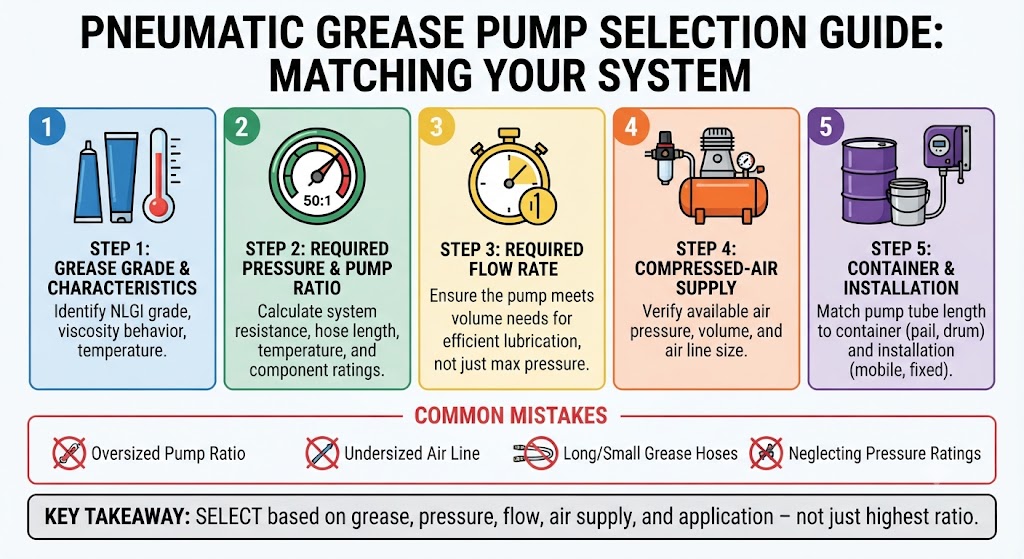
Pneumatic Grease Pump Selection Table
| Selection Factor | What to Check | Why It Matters |
|---|---|---|
| Grease Type | NLGI grade, viscosity behavior, temperature | Affects pumpability and line resistance |
| Pump Ratio | Required fluid pressure versus available air pressure | Helps overcome system resistance safely |
| Flow Rate | Required grease volume and service speed | Determines lubrication productivity |
| Air Supply | Pressure, airflow, filtration, regulator, pipe size | Insufficient air can reduce pump performance |
| Delivery Distance | Hose length, diameter, fittings, reels | Longer systems can create greater pressure loss |
| Container Size | Pail, drum, barrel, or reservoir dimensions | Determines pump tube and mounting configuration |
| Duty Cycle | Occasional, frequent, or continuous operation | Affects pump size and expected service life |
Common Pneumatic Grease Pump Mistakes and How to Avoid Them
1. Choosing the Highest Pump Ratio Without Calculating the System
Higher pressure is not automatically better. An excessively high ratio can increase system stress if pressure is not correctly regulated. Select the pump based on actual application resistance and component ratings rather than assuming that the largest ratio provides the best performance.
2. Ignoring Grease Pumpability
Two products described as grease may behave very differently inside a lubrication system. Temperature, consistency, formulation, and storage conditions all influence how easily grease can be transferred. Verify lubricant compatibility before selecting the pump.
3. Using an Undersized Air Line
A facility may have adequate compressor pressure but still experience poor pump performance because the air pipe, regulator, connector, or hose cannot supply sufficient airflow. Always evaluate the complete pneumatic supply path.
4. Using Excessively Long or Small-Diameter Grease Hoses
Long grease lines and restrictive fittings increase pressure loss. Before increasing pump pressure, check whether the hose layout can be improved by reducing unnecessary length, bends, restrictions, or undersized components.
5. Allowing Air Pockets Into the Grease Supply
Poor drum changes or incorrect loading may introduce air into the grease. This can result in inconsistent delivery or loss of prime. Proper grease handling and the use of a suitable follower plate can help maintain reliable pump pickup.
6. Neglecting Pressure Ratings
The maximum pressure rating of the pump is not the only number that matters. Hoses, reels, swivels, couplers, meters, dispensing valves, fittings, and downstream components must all be suitable for the system's maximum possible pressure.
7. Waiting Until the Pump Fails Before Performing Maintenance
Preventive inspection is more effective than responding only after grease delivery stops. Air leaks, abnormal cycling, worn seals, loose connections, contaminated air, damaged hoses, and poor grease pickup should be addressed before they develop into larger failures.
Pneumatic Grease Pump Best Practices for Reliable Operation
1. Use Clean and Properly Regulated Compressed Air
Air quality directly affects pneumatic equipment. Follow the pump manufacturer's requirements for filtration, regulation, lubrication where applicable, air pressure, and hose sizing. Avoid supplying more air pressure than necessary for the job.
2. Keep Grease Clean During Drum Changes
Dust, metal particles, water, and other contamination can enter grease during storage or container changes. Clean the pump tube, follower plate, drum cover, and surrounding area before transferring the pump to a new container.
3. Monitor Pump Cycling Behavior
A pump that cycles unexpectedly while no grease is being dispensed may indicate a leak or another system issue. Sudden changes in cycling speed, sound, pressure, or delivery rate should be investigated rather than treated as normal operation.
4. Use a Preventive Inspection Checklist
Periodically inspect air connections, fluid connections, grease hoses, reels, couplers, follower plates, pump mounting hardware, pressure controls, and dispensing equipment. Maintenance intervals should be based on operating frequency, environment, lubricant, and the manufacturer's instructions.
5. Design the Whole Lubrication System, Not Just the Pump
The best pneumatic grease pump cannot correct a poorly designed lubrication network. Pump ratio, hose diameter, delivery distance, grease grade, operating temperature, fittings, dispensing points, and air supply should be considered as one complete system.
Conclusion: How to Choose the Right Pneumatic Grease Pump
A pneumatic grease pump can make industrial lubrication faster, more consistent, and easier to manage when compared with repeated manual grease transfer. However, successful operation depends on selecting the right pump for the actual system rather than focusing on a single specification.
Before purchasing a pneumatic grease pump, identify the lubricant, required delivery pressure, target flow rate, air supply capacity, hose length, lubrication-point resistance, operating frequency, container size, ambient temperature, and installation configuration. Then compare those requirements with the manufacturer's pump performance data and maximum working limits.
Next Step: Before requesting a quotation, prepare your grease grade, container size, required hose length, available air pressure and airflow, number of lubrication points, operating frequency, and required delivery rate. Providing these details allows a supplier to recommend a pneumatic grease pump based on the actual application instead of guessing from pressure ratio alone.
Pneumatic Grease Pump FAQ
Q1: What is a pneumatic grease pump?
A pneumatic grease pump is an air-powered pump used to transfer grease from a pail, drum, reservoir, or barrel to lubrication points. Compressed air drives the pump mechanism, allowing grease to be delivered through hoses, reels, valves, or centralized lubrication lines.
Q2: How does a pneumatic grease pump work?
Compressed air operates a reciprocating air motor connected to the pumping section. The pump draws grease from the container and pushes it through the outlet. When downstream demand changes, pump cycling changes according to the design of the pump and lubrication system.
Q3: What does the ratio on a pneumatic grease pump mean?
The pump ratio describes the relationship between air pressure acting on the pump and theoretical fluid pressure output. It should be used as a selection parameter rather than a guarantee of actual pressure, because real performance depends on system resistance and operating conditions.
Q4: Is a higher pneumatic grease pump ratio always better?
No. A higher ratio provides greater theoretical pressure potential but may not be necessary for every application. The correct ratio should be selected according to grease type, delivery distance, pressure loss, required flow, component ratings, and available air pressure.
Q5: What grease can be used with a pneumatic grease pump?
Grease compatibility depends on the specific pump. Check the manufacturer's approved lubricant range, maximum NLGI grade, materials compatibility, operating temperature, and pumpability requirements before using a new grease.
Q6: Why is my pneumatic grease pump running but not pumping grease?
Possible causes include an empty container, loss of prime, air pockets, poor grease pickup, clogged lines, restrictive fittings, cold or difficult-to-pump grease, damaged seals, or another pump fault. Follow the manufacturer's troubleshooting procedure before disassembling the unit.
Q7: Does hose length affect pneumatic grease pump performance?
Yes. Longer hoses, smaller internal diameters, bends, reels, fittings, and cold grease increase resistance to flow. The complete delivery line should therefore be considered when calculating the required pump pressure and flow performance.
Q8: Do I need a follower plate with a pneumatic grease pump?
A follower plate is often useful for drum and pail grease systems because it helps keep lubricant directed toward the pump inlet, reduces air pockets, and limits grease remaining on the container wall. Suitability depends on the pump and container design.
Q9: How often should a pneumatic grease pump be maintained?
Maintenance frequency depends on operating hours, duty cycle, air quality, environment, lubricant, and pump model. Regular inspection should include air leaks, grease leaks, hoses, connections, pressure controls, pump cycling behavior, and the maintenance items specified by the manufacturer.
Q10: What information should I provide when buying a pneumatic grease pump?
Provide the grease type and NLGI grade, container size, available air pressure and airflow, required hose length, number of lubrication points, expected operating frequency, desired flow, installation environment, and any pressure limitations in the existing system.
 立即聯絡
立即聯絡 加入好友
加入好友