

What Is a Facial Tissue Packing Machine?
A Facial Tissue Packing Machine is industrial packaging equipment used to automatically wrap and seal facial tissue products after folding, cutting, and stacking. It is usually installed after a facial tissue converting line and serves as the bridge between tissue production and finished retail packaging.
Depending on the machine configuration, the equipment may pack soft tissue bundles in plastic film, place tissue stacks into cartons, wrap multiple packs together, print production codes, apply labels, count finished packs, and transfer them to secondary packaging or case-packing equipment. For manufacturers pursuing higher productivity, stable package quality, and lower manual labor dependency, the Facial Tissue Packing Machine is a critical part of the overall production system.
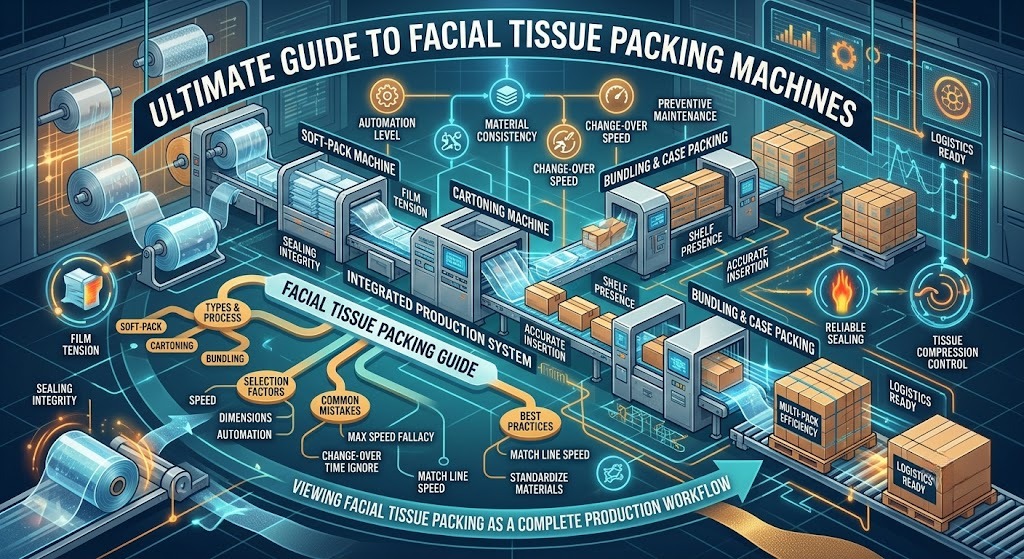
The term can refer to several different machine categories. Some machines are designed specifically for soft-pack facial tissues, while others handle boxed tissues, film overwrapping, multi-pack bundling, or automatic case packing. Therefore, buyers should not compare machines by speed alone. The tissue format, package dimensions, film type, sealing method, automation level, and compatibility with upstream equipment are equally important.
Key Point: A Facial Tissue Packing Machine should be selected as part of a complete production workflow rather than as an isolated machine. The most suitable solution is the one that matches the product size, packaging style, line speed, operator capability, and factory layout.
Why Is a Facial Tissue Packing Machine Important?
Tissue production can be highly repetitive. Once the paper is folded and cut, each pack must be counted, aligned, wrapped, sealed, checked, and moved to the next stage. When these operations rely heavily on manual labor, manufacturers often face inconsistent packaging quality, bottlenecks, higher labor costs, and difficulty scaling production.
1. Higher Production Consistency
Automated packing equipment can maintain more consistent package dimensions, film tension, sealing positions, and pack counts. This is especially important for branded retail products because uneven packs or poor seals can affect shelf appearance and customer perception.
2. Reduced Manual Handling
Manual tissue packing requires operators to repeatedly handle lightweight, compressible products. A Facial Tissue Packing Machine automates many of these repetitive actions, helping factories allocate labor to inspection, maintenance, material replenishment, and other tasks that require more judgment.
3. Better Line Integration
Modern packaging equipment can often be integrated with upstream folding machines and downstream cartoning, bundling, case packing, conveying, coding, and inspection systems. This allows manufacturers to build a more continuous production flow and reduce manual transfer between processes.
4. Improved Packaging Appearance
Packaging is not only protective; it is also part of the product presentation. Accurate film feeding, clean seals, aligned graphics, consistent package shape, and proper tissue compression all contribute to a more professional retail appearance.
5. Easier Production Scaling
As order volume increases, manual packing can quickly become a bottleneck. An automated Facial Tissue Packing Machine helps manufacturers increase output while keeping package quality more stable, provided the upstream and downstream equipment are properly balanced.
Common Types of Facial Tissue Packing Machines
Not every tissue manufacturer requires the same packaging machine. The correct machine type depends primarily on the final package format and production strategy.
Soft-Pack Facial Tissue Packing Machine
This machine wraps stacked facial tissues with flexible film to create compact soft packs. It is commonly used for household tissues, travel tissues, commercial tissues, and private-label products. Important factors include film feeding stability, tissue compression control, sealing quality, and the machine's ability to accommodate different pack lengths, widths, and heights.
Box Tissue Cartoning Machine
A box tissue packing system inserts folded tissue stacks into preformed or automatically erected cartons. Depending on the line, it may also close carton flaps, apply adhesive, print codes, and discharge completed boxes to a conveyor.
Multi-Pack Bundling Machine
Retailers often sell facial tissues in multi-pack formats. A bundling machine groups individual soft packs or boxes and wraps them together using film. The grouping pattern, pack stability, film shrink characteristics, and final bundle dimensions must all be considered.
Secondary Case Packing Machine
For larger plants, individual tissue products may be automatically loaded into shipping cases. This reduces manual case packing and can connect the consumer-packaging stage to palletizing and warehouse logistics.
How Does a Facial Tissue Packing Machine Work?
Although different models use different mechanical layouts, most automated tissue packaging systems follow a similar production sequence.
Step 1: Tissue Infeed and Alignment
Folded and cut tissue stacks are delivered from the upstream machine or loaded onto the packing conveyor. Sensors and guides help maintain proper spacing and orientation before packaging begins.
Step 2: Product Counting and Positioning
The machine confirms product presence and positions the tissue stack for wrapping or cartoning. Stable positioning is especially important because facial tissues are lightweight and compressible.
Step 3: Packaging Material Feeding
Packaging film or cartons are fed into the machine. Film registration systems may be used when printed packaging must align correctly with the finished pack. Consistent material tension is important to avoid wrinkles, misalignment, or weak seals.
Step 4: Wrapping, Folding, and Sealing
The product is wrapped or inserted into its package. Depending on the design, the machine may use heat sealing, adhesive, mechanical folding, or a combination of methods. Accurate sealing temperature, pressure, and timing are critical for reliable package integrity.
Step 5: Inspection and Discharge
Finished packs are discharged to the next process. Depending on the production line, additional equipment may perform coding, weight checking, metal detection, visual inspection, bundling, case packing, or palletizing.
Facial Tissue Packing Machine Comparison Table
| Machine Type | Typical Application | Main Advantages | Key Selection Factors |
|---|---|---|---|
| Soft-Pack Machine | Plastic-film wrapped facial tissue packs | Compact packaging, high automation potential, good retail presentation | Film type, package size, sealing method, speed, changeover time |
| Cartoning Machine | Box facial tissues | Rigid package, strong shelf presence, printable carton surface | Carton dimensions, insertion accuracy, glue system, carton quality |
| Bundling Machine | Multi-pack retail bundles | Efficient grouping for wholesale and retail promotions | Bundle pattern, film properties, pack stability, shrink process |
| Case Packing Machine | Shipping cartons and secondary packaging | Lower manual labor, easier warehouse handling | Case size, loading pattern, line speed, downstream logistics |
Common Buying Mistakes and Risks
- Comparing only maximum speed: A higher advertised speed is not useful if the upstream folding machine, material quality, or downstream line cannot support it.
- Ignoring product changeover: Plants producing several tissue sizes should evaluate how long it takes to switch dimensions and packaging formats.
- Choosing the machine before defining packaging material: Film thickness, sealing characteristics, print registration, and carton quality can directly affect machine performance.
- Underestimating factory layout: Machine footprint, access doors, maintenance space, conveyors, electrical cabinets, and operator access all require planning.
- Ignoring spare parts availability: A technically advanced machine can still create long downtime if critical parts are difficult to source.
- Focusing only on purchase price: Energy use, film waste, maintenance, labor requirements, changeover time, and downtime affect the real operating cost.
- Skipping production trials: Whenever possible, buyers should test the actual tissue dimensions and packaging material before final acceptance.
Best Practices for Better Packaging Efficiency
1. Match Packaging Speed to the Entire Production Line
The packaging machine should not be significantly slower than the tissue converting line, but it also does not need excessive unused capacity. A balanced line typically operates more smoothly than a system where one machine repeatedly starves or overloads another.
2. Standardize Packaging Materials
Frequent changes in film thickness, friction, sealing behavior, or carton quality can cause unstable machine performance. Creating clear material specifications can reduce adjustment time and improve production repeatability.
3. Plan Preventive Maintenance
Sealing components, belts, bearings, sensors, pneumatic parts, cutters, and film-feeding systems should be inspected regularly. Preventive maintenance is usually less disruptive than waiting for a critical component to fail during peak production.
4. Track Waste and Downtime
Manufacturers should monitor film waste, rejected packages, sealing faults, jam frequency, changeover duration, and unplanned downtime. These indicators reveal whether the Facial Tissue Packing Machine is operating efficiently or requires process optimization.
5. Train Operators Beyond Basic Start and Stop Functions
Operators should understand normal machine behavior, alarm conditions, safe cleaning procedures, basic adjustments, and common fault causes. Better training can reduce unnecessary maintenance calls and improve production recovery after minor stoppages.
Conclusion: How to Choose the Right Facial Tissue Packing Machine
A Facial Tissue Packing Machine is a key piece of equipment for manufacturers that want to improve packaging consistency, increase automation, reduce repetitive manual handling, and build a more scalable tissue production line. However, choosing the right machine involves much more than looking at advertised packing speed.
Buyers should first define the tissue format, finished package dimensions, packaging material, expected output, number of product sizes, required changeover frequency, available factory space, operator skill level, and maintenance resources. After that, they can compare machine configurations based on actual production needs rather than headline specifications.
The most effective purchasing strategy is to evaluate the Facial Tissue Packing Machine as part of a complete production system. Upstream folding and cutting equipment, infeed conveyors, packaging materials, inspection systems, bundling equipment, case packing, and warehouse flow should all be considered together. This system-level approach can reduce bottlenecks and make future capacity expansion easier.
Next Step: Before requesting a quotation for a Facial Tissue Packing Machine, prepare your tissue dimensions, pack size, packaging material, target speed, electrical standard, factory layout, and required automation level. Providing these specifications helps suppliers recommend a more suitable machine configuration.
 立即聯絡
立即聯絡 加入好友
加入好友