

What Is a HEAVY DUTY DOOR?
A HEAVY DUTY DOOR is designed for demanding commercial, industrial, institutional, and service environments where a door may experience frequent operation, physical impact, heavy hardware loads, or challenging environmental conditions. Compared with a basic interior door, a heavy duty door typically uses stronger construction and is specified with components intended to support more demanding applications.
The term HEAVY DUTY DOOR does not refer to one single product design. Depending on the application, it can include reinforced steel doors, stainless steel doors, industrial service doors, security doors, heavy duty commercial doors, and other specialized door systems. The actual performance depends on the complete assembly, including the door leaf, frame, hinges, locks, closer, seals, and other hardware.
A door used in a busy warehouse, factory, hospital, or school can face hundreds or thousands of operating cycles over time. It may also be exposed to carts, equipment, deliveries, cleaning procedures, moisture, dust, or accidental impact. In these situations, selecting a door based only on initial price may not provide the best long-term value.
For this reason, HEAVY DUTY DOOR selection should begin with the actual application. Traffic frequency, door size, opening direction, security requirements, environmental exposure, hardware, and maintenance expectations should all be reviewed before choosing a specific specification.
Key Benefits of a HEAVY DUTY DOOR
The main reason buyers consider a HEAVY DUTY DOOR is to achieve a better match between the door system and the demands of the building. A well-specified door can provide several practical advantages.
Higher Durability
Heavy duty construction is intended for applications where ordinary doors may experience excessive wear. Reinforced components and suitable hardware can help the door withstand repeated operation and everyday commercial use.
Better Impact Resistance
Warehouses, factories, kitchens, and service areas may expose doors to carts, trolleys, equipment, and other sources of impact. A suitable heavy duty configuration can provide greater resistance to this type of physical use.
Support for Commercial Hardware
Commercial openings may require door closers, panic exit devices, access control, security locks, kick plates, pull handles, vision panels, or electronic hardware. A HEAVY DUTY DOOR can be configured to accommodate the hardware requirements of demanding applications when properly specified.
Potentially Lower Lifecycle Costs
The initial price of a heavy duty door may be higher than a basic commercial door. However, in a high-traffic environment, a more durable system may reduce the frequency of repairs or premature replacement. Lifecycle cost should therefore be considered alongside purchase price.
HEAVY DUTY DOOR vs Standard Commercial Door
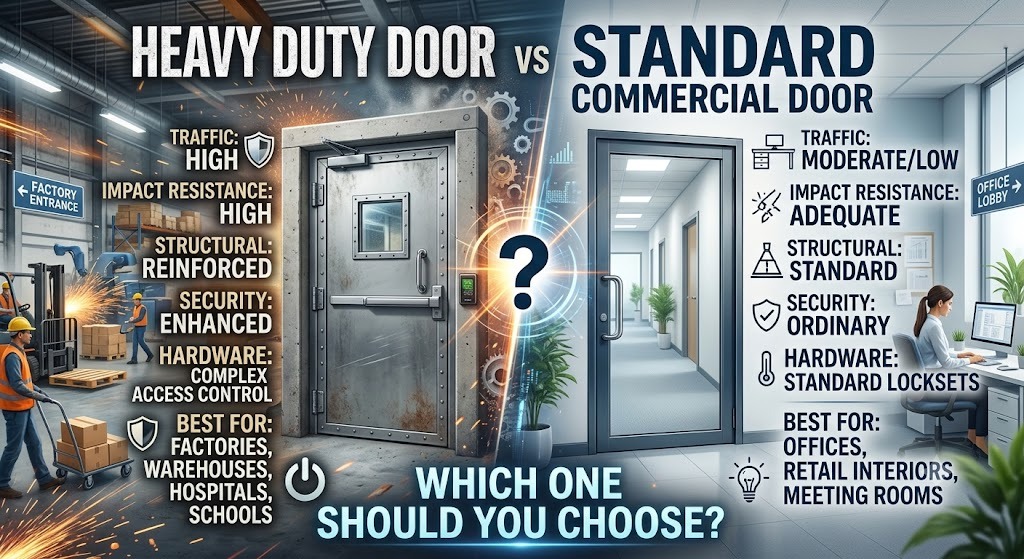
The difference between a HEAVY DUTY DOOR and a standard commercial door is mainly related to intended use, construction, hardware requirements, and expected operating conditions. A standard door is not necessarily inferior; it may simply be designed for a less demanding environment.
| Item | HEAVY DUTY DOOR | Standard Commercial Door | Suitable For |
|---|---|---|---|
| Traffic | High-frequency and demanding use | Low to moderate traffic | Choose based on opening cycles |
| Construction | Reinforced and application-focused | Standard commercial construction | Heavy duty for demanding areas |
| Impact Resistance | Designed for greater physical abuse | Suitable for normal use | Factories and warehouses favor heavy duty |
| Hardware | Suitable for demanding commercial hardware | Standard hardware options | Access-controlled or high-cycle openings |
| Security | Can be specified for higher security requirements | Basic commercial security | Restricted areas favor heavy duty |
| Environmental Exposure | Can be configured for demanding conditions | Better for standard environments | Match material to the environment |
| Customization | Broad customization potential | Usually simpler specifications | Custom projects favor heavy duty systems |
| Initial Cost | Usually higher | Usually lower | Budget-sensitive areas may prefer standard |
| Lifecycle Value | Potentially better for high-use applications | Suitable where operating demands are lower | Compare total cost, not only purchase price |
| Best Match | Industrial and high-traffic locations | Offices and ordinary commercial areas | Use the door according to the application |
The most important lesson is that a HEAVY DUTY DOOR should not automatically be installed everywhere. If an office door is used infrequently and faces little physical abuse, paying for industrial-level construction may not provide meaningful additional value. On the other hand, using a basic door in a busy loading corridor can create maintenance and replacement issues.
Where Are HEAVY DUTY DOORS Used?
HEAVY DUTY DOORS are commonly considered for buildings where durability, security, high traffic, or environmental resistance is important. The exact specification should always be matched to the application.
- Factories: production rooms, machinery areas, utility rooms, and internal industrial access points.
- Warehouses: loading areas, storage rooms, employee entrances, and high-traffic circulation routes.
- Hospitals: service corridors, utility rooms, maintenance areas, and selected high-use openings.
- Schools: entrances, service areas, maintenance rooms, and frequently used corridors.
- Commercial Kitchens: areas exposed to carts, moisture, cleaning, and frequent staff movement.
- Data Centers: controlled-access rooms where security and reliable operation are important.
- Retail Facilities: stock rooms, delivery areas, employee access points, and back-of-house spaces.
- Parking and Utility Facilities: stairwells, plant rooms, service areas, and restricted-access zones.
The operating environment matters just as much as the building type. A door installed in a dry indoor warehouse may have different material requirements from a door exposed to coastal air, chemical cleaning, humidity, temperature changes, or frequent wash-down procedures.
3 Buying Scenarios: Which HEAVY DUTY DOOR Is Right for You?
Scenario 1: New Buyer or First Commercial Project
If you are buying commercial doors for the first time, begin by identifying how the opening will actually be used. Consider the number of users, opening frequency, equipment movement, security requirements, and environmental exposure. Do not choose a door simply because the product description says “heavy duty.”
For a low-traffic office, a standard commercial door may be enough. For a factory, warehouse, service corridor, or high-use institutional building, a HEAVY DUTY DOOR may be more appropriate.
Scenario 2: Budget-Conscious Buyer
If controlling upfront spending is the main concern, avoid automatically selecting the cheapest door. Instead, divide the project into different performance zones. Use heavy duty specifications where traffic or impact justifies them, and use standard commercial doors in lower-demand areas.
This approach can help prevent unnecessary overspecification while maintaining appropriate durability in critical areas.
Scenario 3: Buyer Focused on Performance and Efficiency
If your priority is reliable operation in a demanding environment, a HEAVY DUTY DOOR should be evaluated as a complete door assembly. Door leaf strength, frame construction, hinges, closer, locking system, seals, and access control should work together.
For facilities where a damaged or non-operational door can interrupt workflow, the additional initial investment may be easier to justify when compared with potential maintenance, downtime, and replacement costs.
HEAVY DUTY DOOR Materials and Construction
Steel
Steel is widely considered for heavy duty commercial and industrial doors because it offers strength and durability with a broad range of fabrication and finishing options. The final performance depends on the specific gauge, reinforcement, frame, coating, hardware, and construction method.
Stainless Steel
Stainless steel may be appropriate for applications where corrosion resistance, hygiene, cleaning, or appearance is particularly important. It is commonly considered in food-related facilities, healthcare environments, wet areas, and other demanding locations.
Reinforced Construction
Reinforcement is especially important around hinges, locks, closers, panic devices, and other hardware attachment points. A strong door leaf alone does not guarantee a durable opening if the supporting frame or hardware preparation is inadequate.
Frame and Hardware
The frame should be selected according to the door weight, wall construction, installation method, traffic, and hardware. Hinges, closers, locks, exit devices, and access control components should also be matched to the door system rather than treated as separate afterthoughts.
Features to Compare Before Buying a HEAVY DUTY DOOR
Before comparing suppliers, create a specification checklist. This makes it easier to identify whether two quotations are genuinely comparable.
| Feature | What to Check |
|---|---|
| Door Material | Steel, stainless steel, or another specified material appropriate for the environment. |
| Door Thickness | Confirm the actual construction rather than judging by the product name alone. |
| Frame | Frame profile, material, anchoring, reinforcement, and wall compatibility. |
| Hinges | Weight capacity, cycle requirements, and hardware compatibility. |
| Closer | Closing force and suitability for door size, weight, and traffic. |
| Locking System | Mechanical lock, panic hardware, electronic access, or other requirements. |
| Finish | Paint, powder coating, stainless finish, or corrosion-resistant treatment. |
| Seals | Weather, smoke, acoustic, hygiene, or other sealing requirements where applicable. |
| Compliance | Applicable fire, egress, accessibility, security, or project-specific requirements. |
HEAVY DUTY DOOR Cost and Pricing Factors
The price of a HEAVY DUTY DOOR can vary significantly because commercial door systems are often customized according to project requirements. Size, material, reinforcement, frame construction, hardware, finish, quantity, and installation conditions can all affect the final quotation.
- Door dimensions: oversized or non-standard openings may require additional fabrication.
- Material: steel and stainless steel have different material and fabrication costs.
- Reinforcement: additional support for heavy hardware can affect manufacturing requirements.
- Frame: frame construction and installation conditions can influence the total system cost.
- Hardware: closers, panic devices, security locks, and access control can add to the project cost.
- Finish: specialty finishes and corrosion-resistant treatments may affect pricing.
- Performance requirements: fire, security, acoustic, hygienic, or other specifications may require specialized products.
- Installation: replacement work, difficult access, and wall modifications may change the final installation cost.
When requesting multiple quotations, provide the same specification to every supplier. Comparing a door-only price with a complete door, frame, hardware, delivery, and installation package can produce an inaccurate conclusion about which supplier offers better value.
6 HEAVY DUTY DOOR Buying Mistakes to Avoid
- Choosing only by the lowest price. Initial price does not show the full lifecycle cost of a high-use door.
- Ignoring the frame. A strong door leaf needs an appropriately designed frame and anchoring system.
- Using unsuitable hardware. Hinges and closers should match the weight, size, and traffic level.
- Overlooking the environment. Moisture, chemicals, salt air, and cleaning requirements can influence material selection.
- Adding access control too late. Electrical preparation and reinforcement are easier to coordinate during the original specification.
- Assuming every HEAVY DUTY DOOR is identical. Compare actual construction, materials, reinforcement, hardware, and intended application.
How to Choose the Right HEAVY DUTY DOOR
The easiest way to choose the right HEAVY DUTY DOOR is to work backward from the application. Instead of starting with a product name, define what the opening must do and then select the construction and hardware required to meet those conditions.
- Identify the location. Determine whether the door is for an office, warehouse, factory, service area, exterior entrance, plant room, or restricted space.
- Estimate traffic. Consider how often the door will open and close during a normal operating day.
- Identify impact risks. Consider carts, trolleys, forklifts, equipment, deliveries, and other physical contact.
- Define security requirements. Decide whether the opening needs standard locking, restricted access, panic hardware, or electronic access control.
- Check environmental exposure. Review humidity, chemicals, cleaning, weather, salt air, dust, and temperature.
- Select compatible hardware. Confirm hinges, closer, lock, exit device, handles, seals, and accessories.
- Compare lifecycle value. Review purchase price, maintenance, expected use, and potential replacement requirements together.
For large commercial or industrial projects, creating a door schedule can make procurement more efficient. Each opening can be assigned a door type, size, material, frame, hardware set, finish, and performance requirement. This approach helps avoid buying an unnecessarily expensive door for low-demand areas while ensuring critical openings receive an appropriate HEAVY DUTY DOOR specification.
HEAVY DUTY DOOR FAQ
Q1: What is the difference between a HEAVY DUTY DOOR and a standard commercial door?
A HEAVY DUTY DOOR is generally designed for higher traffic, greater physical impact, heavier hardware, and more demanding operating conditions. A standard commercial door is often suitable for lower-traffic offices, retail areas, and ordinary interior applications.
Q2: How much does a HEAVY DUTY DOOR cost?
The cost depends on size, material, construction, frame, reinforcement, hardware, finish, performance requirements, quantity, and installation conditions. A project-specific quotation is more accurate than relying on a general price range.
Q3: How long does a HEAVY DUTY DOOR take to manufacture?
Manufacturing time depends on the door design, dimensions, quantity, material, customization, hardware, finish, and supplier production schedule. Custom projects generally require more coordination than standard stock products.
Q4: Who should use a HEAVY DUTY DOOR?
It is commonly considered for factories, warehouses, hospitals, schools, commercial kitchens, plant rooms, service corridors, loading areas, restricted-access spaces, and other locations with high traffic or demanding operating conditions.
Q5: What are the disadvantages of a HEAVY DUTY DOOR?
The main disadvantages can include a higher initial purchase price, heavier hardware requirements, and potential overspecification for low-traffic areas. The door should be selected according to actual operating conditions.
Q6: Is a steel door automatically a HEAVY DUTY DOOR?
No. Steel doors are available in different construction levels. Door material alone does not define heavy duty performance. Door construction, reinforcement, frame, hardware preparation, and intended use should all be evaluated.
Q7: Can a HEAVY DUTY DOOR be used with access control?
Yes. Depending on the design, a heavy duty commercial opening can be prepared for electronic locks, electric strikes, magnetic locks, card readers, exit devices, door position switches, and other access control components.
Q8: Is stainless steel better than painted steel for a HEAVY DUTY DOOR?
Not necessarily. Stainless steel can be advantageous in corrosive, humid, hygienic, or frequently cleaned environments, while coated steel may be a more economical option for many standard commercial and industrial applications.
Q9: Does a HEAVY DUTY DOOR require special hinges and closers?
It may. The hinges and closer should be selected according to the door size, weight, traffic level, operating frequency, and hardware requirements. An unsuitable hinge or closer can affect the performance of the complete door assembly.
Q10: How do I choose the right HEAVY DUTY DOOR supplier?
Compare suppliers based on door construction, material choices, frame design, hardware compatibility, customization capability, technical support, quotation details, manufacturing quality, and experience with similar commercial or industrial applications.
 立即聯絡
立即聯絡 加入好友
加入好友